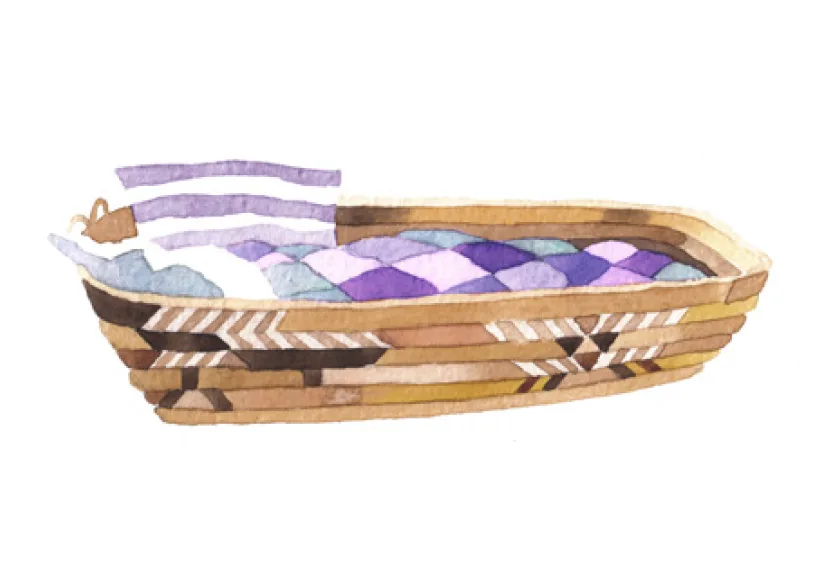
ɬaqʷatčxʷ pɩčos čʊy (threading the lace)
ɬaqʷatčxʷ pɩčos čʊy refers to threading the lace on the baby’s basket. This wraps tight around the baby and makes them feel snug, secure, and loved. Tla’amin qaymɩxʷ believe in the importance of all of our people feeling that sense of security and belonging. We’ve also heard that getting to know a particular child or family is necessary before deciding how to support them, because everyone is different, and every situation is different.

ɬaqʷatčxʷ pɩčos čʊy represents our commitment to inclusion and belonging. It reminds us that being curious and responsive to uniqueness is part of the Tla’amin Service Model, including considering:
Gender
We all have important roles in our families and Nation. This includes təmtumɩš, nagəptiy, and people of all genders, including t̓əmǰɛ. Learning about the functions we all have to play and having opportunities to fulfill them is part of the Tla’amin Service Model.
“The dog children story to me is the resilience of just being a woman. In that story she’s left, she’s pregnant. She doesn’t try to leave. She stays and has her children. She creates her own environment, shows them what she’s been taught, and then everyone comes back. She’s strong and takes control.
“čičyɛ was always the protector of the children.”
“I was trained as a counsellor, but when I heard Elders talking, they said ‘you have to be proud of who you are’. That’s when I started to do different things with the men I worked with: spiritual bath, into the forest, getting different medicines. When I started doing that, the guys started to change. Because that’s who they are. It’s an identity thing. It was teaching them respect.”
“Two-spirit identity was new to me about 10 years ago. When I learned about that part of our culture and heritage, that felt good to me. There was a term for this, before everything. I wish that was more prevalent in our teachings. I think the binary influence of catholicism damaged us pretty well. I didn’t know the word for it until today.
Ability
From a Tla’amin perspective, we are all acknowledged and embraced for our gifts, including children, youth, and adults with a wide range of abilities and support needs. This reminds us that the differences among us make us stronger, and requires that we create opportunities for everyone to participate and experience belonging.
“A vision is that there would be a safe play space for children with all abilities, considering their physical challenges and also providing access to children who have different sensory preferences. I dream of having accessible trails for community members to get out into nature and maybe having a community track chair that can be used by any member with physical challenges.”
“I think it would have been more successful if I had had some knowledge of FASD. I had no knowledge of any of that and the behaviours that come with that. I don’t think I was supported enough.”
“There are other areas in the community that are not accessible for a wheelchair – trying to get down onto the beach in the community. Being able to get in the water is important for enjoying summer.”
People living on and off Tla’amin lands
Regardless of where we live, we are one Nation. We are all relatives: tuwʊšt and people living on Tla’amin territory. This reminds us that building and maintaining connections with our ǰɛʔaǰɛ can happen on Tla’amin lands, virtually, and in urban and other communities.
“I only recently was able to find the Tla’amin Nation website and the Facebook Group and starting to reach out to more family and things like that.”
“I know it’s not going to happen for every single one, but something to encourage off lands members to come home, visit their family, participate in ceremony. It’s such a good practice to be holding up people’s mental health and cultural connections.”
“In the city it’s hard for them to find their culture. But it’s really important that the kids know what their culture is. My adopted child doesn’t know his culture, but he learned Coast Salish from us. We took him to culture nights when we lived in [city].”
“I’m only just meeting my family as an adult, and it really sucks because I don’t know my uncles or aunties over there. I’ve never been there [to Tla’amin territory] and I really want to go. And now that I have kids I really want them to know who they are, where their mom came from. I wasn’t given that option, but I want my kids to have that option.”
Sister Nations
komoks, ƛoʔos, χʷɛmaɬku, and ɬəʔamɛn share a language and relations. We were historically one people, and share many teachings that come from living on this land since time immemorial. This reminds us that our relationships with our Sister Nations are some of our most important relationships.
“The Indian Act separated us. Now we’re coming back together, but we have the idea that we’re different.”
“Getting Sister Nations together to host a weekend sports day. Have a good weekend – include drumming and singing. Take turns hosting. That’s where our families are from. That’s often what happens – we’d find relatives when going on a tournament. Get to say hi and see how everyone’s doing. There are a lot of benefits that come with sports – it’s also the connection with the extended families.”