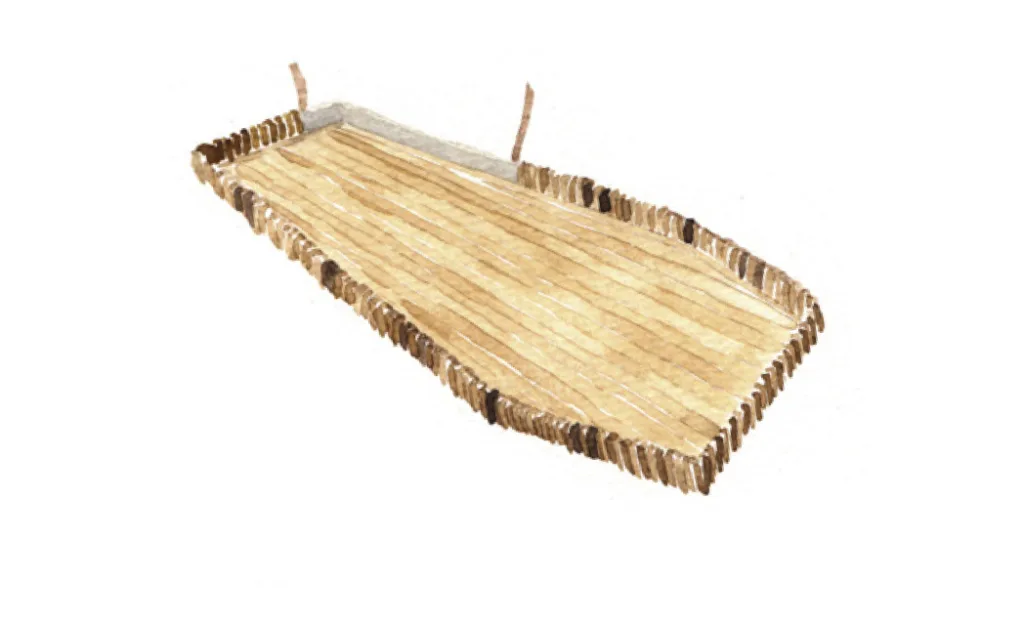
hinəč (building from the bottom up)
To construct the base of a basket is called hinəč, building something from the bottom up. This word reminds us that we must think about and actively build the strong foundations for a Tla’amin Service Model. Making a χa:p̓ involves intentionally planning and crafting wholistic relationships between sticks, roots, bark, and other materials, with the weaver carefully maintaining their own mental, emotional, and spiritual energy while doing the work. This is a learning process and it takes many years to become a master weaver – as we learn, we improve, and we commit to undoing our stitches and fixing mistakes as part of this learning and improving process.

These teachings of relationship, wholism, self-care, and learning are four core pathways in this Service Model. These are the core foundations of the hinəč that, when woven strongly – and interconnected with each other and guided by culture, land, and ʔayʔaǰuθəm – will ensure the χa:p̓ is strong.
Relationships
We have always centered relationships in all we do and there is nothing that we do that doesn’t involve our partnerships with each other. This includes relating with each other in community, with neighbouring Nations, and with governments and other partners. If we are grounded in this Service Model, our relationships can improve the work we do and grow our ability to do more.
“Always introduce. I learned a lot from my grandmother when she was here. Acknowledgement, introduction is so important when people walk through the door, and it doesn’t matter how old they are. Acknowledge a person when they’re coming to your house. That was my Granny’s way. You hear open door policy – that’s how she was. Memories of the stove, and she always had her tea on. Respect and acknowledging was so important. She was one of my teachers in my life.”
“There was a way of gently getting anywhere. The words that you use matter.”
Wholistic programming
We have experienced too much separation, and it is important to approach our Service Model wholistically and collaboratively. This means we work together across programs, departments, buildings, and entities to support the physical, emotional, mental, spiritual, and social wellness of our people.
“Culture and medicines are tools to fight our way back from where we are.”
“We are siloed. We need to get together more. Otherwise, what we’re trying to teach the kids isn’t reflected in the other aspects of the system.”
Care for workers
Caring for ourselves enables us to care for others. Uplifting, healing, learning,and reconnecting are what make us all well. The wholistic wellness of people who are in caregiving roles is a key priority in the Tla’amin Service Model.
“I can use myself as an example, it’s never too late to learn. Learning our language is so difficult for me. Granny used to say: Our kids are always listening, even though they’re playing. They hear us.”
“When I moved in with my first husband’s dad, he taught me [how to cook]. He didn’t go to residential school. He showed me how to do breakfast, laundry, and do it early in the day. How to clean the dishes. Then when I had my kids, I didn’t teach that right away, I did everything for them. I thought that was the right thing to do. But as they got older, I was like ‘OK, they need to learn how to cook’. And so I’m glad they learned at a young age. And now my daughter is teaching her kids to make their lunches.”
“Self-care would involve taking care of the body, and the mind as well. Definitely when the child arrives, you would have to take care of your thoughts and your actions. And even more so when you’re a grandparent. Taking care of energy, taking care of self is crucial.”
Continuous learning and improvement
Our core values include pit qʷayɛgəns and ƛasəm qʷayigən. These values remind us to work hard and do our best, and be willing to change as we learn and grow. A Tla’amin-led system will be better for our people; approaching our Service Model with humility and discipline encourages ongoing improvement in all we do.
“Strength. A lot of people aren’t in great shape when they start [tribal journeys], but then you get out there, you get a feel for it, and get better. Nobody’s perfect when they start, but by the time you’re done with the journey you’ll be so strong: There’s no lily-dipping! Your arms and your mind will be so strong.”
“In order to achieve this vision, we have to look within ourselves first. Self-reflect so we don’t feed into the division. Integrate this into our lives and pass it on. Live it.“
“A lot came from my grandma. She raised me. Anytime my mom was off doing her thing, I’d be at my grandma’s house. Doing things in the community, follow along with her, and talk at the end of the day at the kitchen table: ‘What did you learn from today? What did you see was happening?’ And then she’d share what she saw. It was really great.”
“A lot of parents and grandparents think they can’t do it on their own. You can. You can brush your own child, your own grandchild. You can ask your daughter or son to join you in the living room on a Sunday. My late friend used to do that with her grandson. She gave him a lot of teachings.”