χaƛ (Love)
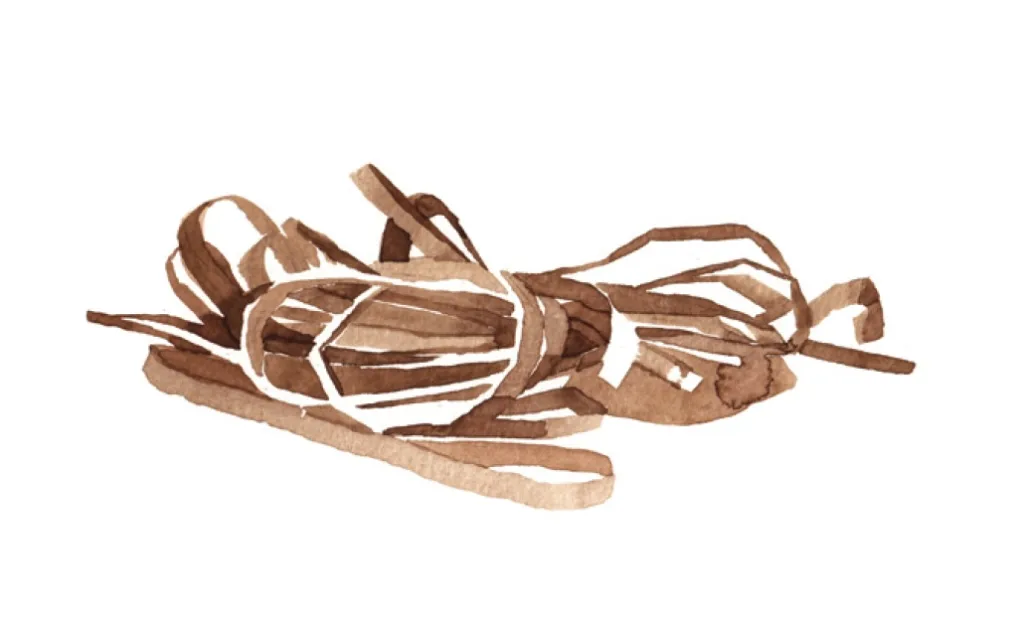
Baby baskets are made with love and care to hold, comfort, and protect our most sacred responsibility: our youngest and most vulnerable ǰɛǰɛ.6 The core purpose of weaving a baby basket is to express love, care, and protection from the Nation, community, and family – and to have that love passed down.
“Children aren’t ours; they’re gifts from the Creator. They’re put on this earth by the Creator for us to look after, so we have to do our best.”
The cedar roots are dug, and then they are carefully cleaned and prepared. Then the baskets are skillfully woven by those who have learned this important skill from others before them. As such, χa:p̓ are crafted by many, many hands and hearts. χa:p̓ are often made for the initial purposes of a particular baby, but are built to last. They are then used by many babies in a family, and this treasured possession is passed down through generations. In this way, a χa:p̓ provides practical and emotional connections among generations past, present, and future, as well as with the land and teachings about family and caring for ourselves and each other. The work to prepare for, develop, use, and pass the χa:p̓ to future generations represents the core purpose statement of the Tla’amin Service Model:
Work together and in our own way to raise current and future generations to be healthy, thriving, and culturally strong.
Each element of this purpose statement was carefully crafted and chosen, and is deeply
meaningful to this Service Model.
Work together
Our teachings are inclusive of everything and everyone and acknowledge our need to look after all and to not leave anyone behind. They remind us that we move forward by working together.
“The protocol is seen and learned [on tribal journeys]: When we get there, we’re on the canoe and our spokesperson would say, “I’m hungry, I’m tired, can we come ashore?” So that’s when we get welcomed into their territory by the host Nation. That’s one protocol; there are different ones. And there are a lot of teachings I learned on Tribal Journeys: respect for all the different Nations; patience is a great big one; strength, culture, and identity. I find the čičyɛ Circle makes you stop and think about these things: identity, respect, patience. Because you have to be very patient for a lot of things that are going on within your family. Teach your kids respect. You’ve got to respect everybody’s going through something in their own life.”
In our own way
Our Nation is self-determining, our governance approach is guided by our taʔow. This reminds us that we move forward by centering who we are and where we come from.
“For me, it’s about teaching our kids our way. When we do our ceremonies – we’ve done them for thousands of years – that’s how we take care of each other, how we look after each other.”
“I am reminded of a conversation I had with my late mother-in-law who spoke of the benefits of living intergenerationally. Before European contact when families lived together, there was a lot of built in support for parents, and many opportunities for children and youth to learn from their grandparents.”
“I’m just very happy that we’re moving things in a new direction, with more of the decision-making coming back to citizens. It builds the community up. It can’t happen soon enough.”
Raise current and future generations
The strength of our taʔow comes from being passed down from generation to generation. As we inherited the taʔow from our ancestors, it is our responsibility to pass that along to future generations. This reminds us that we move forward by always keeping future generations in mind when making decisions today.
“As a child gets older, the teaching [about responsibility] increases for what they are doing in their daily lives, but the love and comfort never stops. It should continue their entire lifetime.”
“What’s important is loving your children, just spending time with them.”
Healthy, thriving, and culturally strong
Our taʔow is our source of well-being. When we all carry the taʔow, we are all well, individually and collectively. This reminds us that from a Tla’amin perspective, wellness means ‘healthy, thriving, and culturally strong’. This reminds us that we move forward by centering the wellness of our people.
“We have to look to what has made families healthy for thousands of years: we look at that as guidance and identity and culture.”
“We all belong, and come from the same place, and stand under the same cedar hat. We maintain that and keep it going.”
This purpose statement is at the heart of every stitch that follows. It reminds us that a Tla’amin Service Model is something we do together, and we already have everything we need right here among and around us.
“People visited house to house in the village. People would just visit. They’d come around with handwritten Christmas cards through the village. People would sit on their porches and watch the world go by. Having the family unit, including grandparents involved in children’s lives.”