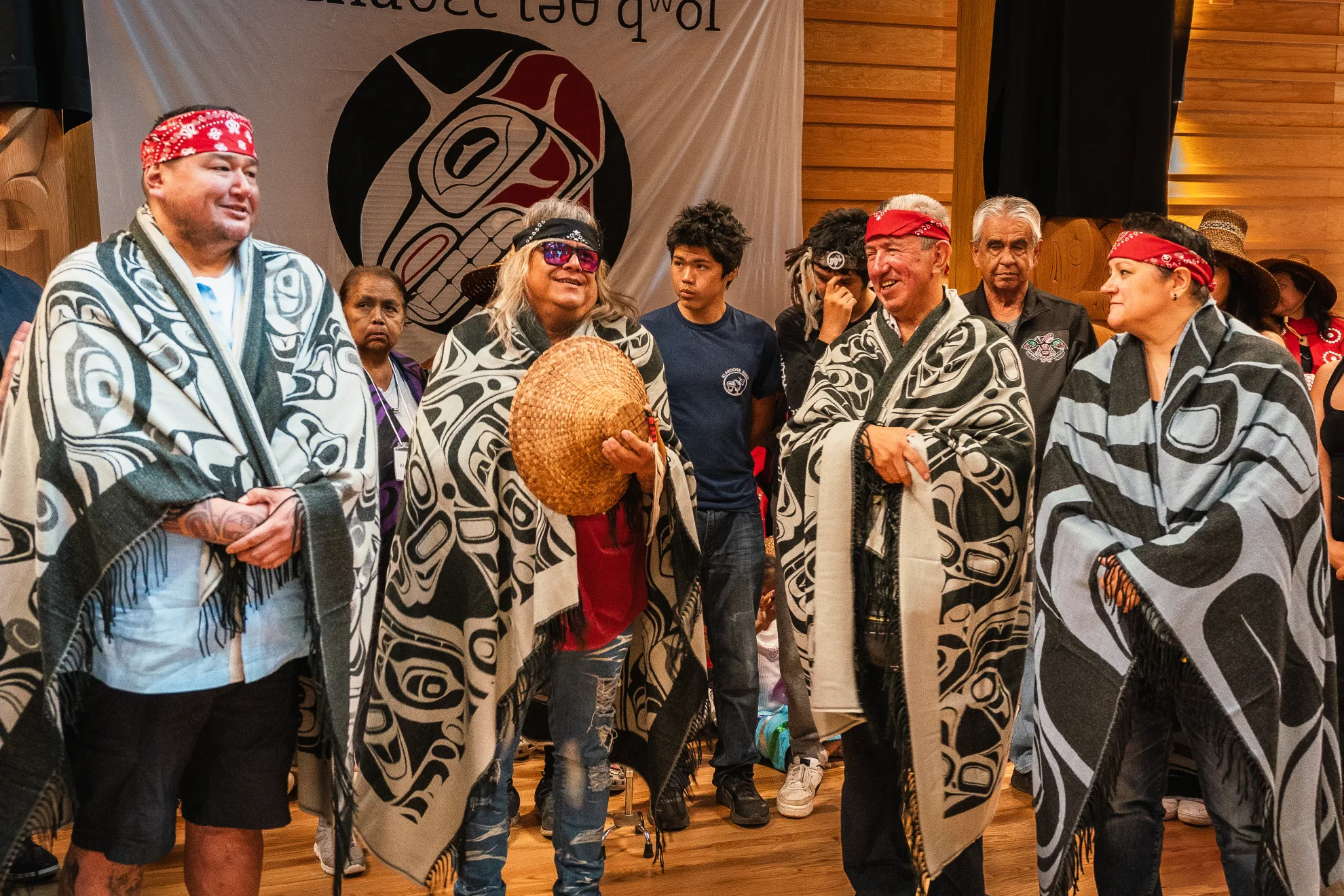
The Tla’amin, Homalco, Klahoose, and K’ómoks are the northernmost Coast Salish ʔayʔaǰuθəm-speaking peoples. Our histories, teachings (ta?əw), and families are interconnected, with subchiefs holding responsibility for different parts of the territory.
Prior to the Indian Act, collectively the Sister Nations we were all one people. With the creation of the reserve system in the early 1900s, the communities were administratively divided, and our people became four distinct bands: Tla’amin Nation, Homalco Nation, Klahoose First Nation, and K’ómoks First Nation.
Read this excerpt from Reflections on Traditional Governance 2004, Siemthut Michelle Washington.
“Culturally, we are linked most closely with all those who speak our language — the Sliammon, Homalco, Klahoose, and Comox. Anthropologists also link us culturally with speakers of two other languages — Pentlatch (now extinct) and Sechelt. Together we comprise the “Northern Coast Salish” grouping within the Northwest Coast culture area.
The overall territory occupied by the Northern Coast Salish prior to around 1800 encompassed the mainland from around Call Inlet in the north to Roberts Creek in the south, and Vancouver Island from Kelsey Bay in the north to around Parksville in the south, including the offshore islands.
We share many Jeh jeh (family ties) and territory. Indeed, the Sliammon, Klahoose, and Homalco are often considered “one people” by academics and Elders alike. We have intermarried extensively with our immediate neighbours and have at times shared villages and resource-gathering areas.
Traditionally, groups who identified themselves as Sliammon, Homalco, and Klahoose each occupied a cluster of villages and recognized a territory associated with these villages. Among the Sliammon and other Northern Coast Salish, however, there was no rigid identification of territory. Precise boundaries were not always clearly delineated through things such as marking the shoreline with boulders, or fighting over property found at the frontiers of one’s lands, as was the case with BC’s other First Nations.
Today, Sliammon people still possess a “mental map” of the Sliammon traditional territory that has been passed down through the generations. Those who resided in Sliammon villages freely used the resources found in their environs, apart from resources such as salmon streams that were owned and taken care of by specific individuals and kin groups and required access through kinship or the permission of leaders.
Kinship, nevertheless, permitted access to resources located beyond original Sliammon territory, to fisheries, clam beds, and hunting areas more commonly associated, for example, with Homalco and Klahoose families.”
One People, One Language
The Tla’amin, Homalco, and Klahoose people have always been one people, speaking ʔayʔaǰuθəm, a dialect of the much larger Coast Salish language family. While dialects developed across geography, the language reflects a shared origin and worldview.
Historically, our people cooperated across borders. Language, territory, and identity flowed through family connections, travel routes, and seasonal movements. We share the same stories, teachings, and responsibilities to the land and waters.
Shared History and Ceremony
For generations, Tla’amin, Homalco, and Klahoose families gathered together during the winter months in q̓aq̓ɛyq̓ay (Grace Harbour).
This place was a centre of governance, ceremony, and decision‑making. Winter ceremonies and potlatches were held here, bringing families together to transfer names, affirm responsibilities, and conduct important work.
In an interview in the early 1900s, Chief Tom Timothy recalled that “all important work was done in q̓aq̓ɛyq̓ay.” Chief Julian of Toba Inlet also remembered living in q̓aq̓ɛyq̓ay as a young child during the winter months and witnessing some of the last winter ceremonies held there.
These gatherings reinforced governance, family ties, and shared law across and between our Sister Nations.
Disruption and Continuity
Colonial systems attempted to divide what had always been connected. Imposed borders, reserves, and administrative categories separated families and Nations that had governed and lived together for thousands of years.
Despite these disruptions, relationships between Sister Nations endured. Families remained connected, language knowledge was carried forward, and shared ceremonies continued whenever possible.
The strength of these relationships is reflected in ongoing cooperation today.
Contemporary Relationships
Today, Tla’amin Nation continues to work closely with Homalco, Klahoose, and K’ómoks on matters of shared importance.
This includes collaboration on:
- Language revitalization and knowledge sharing
- Protection of lands, waters, and territory, including collaboration and dialogue on shared territory stewardship and decision-making
- Canoe journeys and cultural gatherings, including travelling together on regional and coastal canoe journeys, and hosting local journeys that bring families and Nations together on the water
These partnerships reflect both historical responsibility and contemporary Nation-to-Nation cooperation.